
Former key Ion players team up again to redefine innovation real estate
By Jishnu Nair – Reporter, Houston Business Journal | Dec 16, 2025 | Original Article
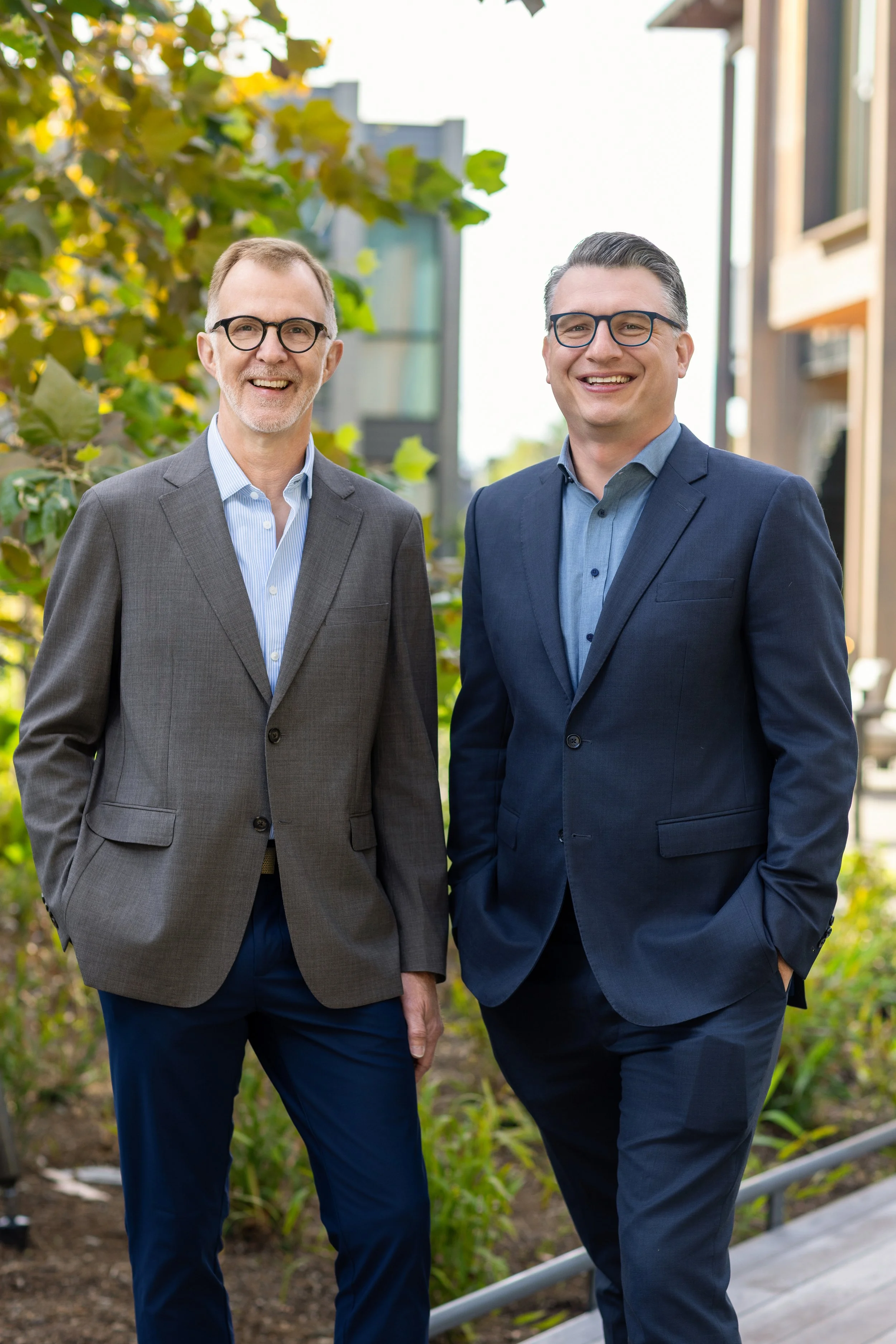
Jan Odegard, new senior advisor at LeVass Ventures (left) and Ryan LeVasseur, founder and managing principal at LeVass.
Story Highlights
Jan Odegard, the Ion's first executive director, has joined Ryan LeVasseur, formerly of Rice Management Co. and Hines, at LeVass Ventures.
The pair helped launch the Ion in 2021 but say their new vision is attracting local talent into buildings post-Covid.
LeVass Ventures is already involved in prominent local projects likethose for the Menil Collection and the Astrodome.
Two of the minds behind Midtown Houston’s Ion District want to redefine the"innovation district" concept under a new partnership.
Ryan LeVasseur and Jan Odegard are teaming up at LeVass Ventures, the Houston-based firm that LeVasseur founded in 2023 after leaving Rice Management Co. Odegard joined as a senior adviser in mid-December, over a year after his own departure from Rice University. The two were heavily involved in the 2021 launch of the Ion District, a 16-acre development in Midtown on Rice-owned land.
“I’ve had the pleasure, over my career, of working with people I found rewarding and complementary, who allowed me to have the autonomy to do the things that I felt I was very good at,” Odegard, who was the Ion’s first executive director, told the Houston Business Journal in an interview. “I thought (with Ryan), 'Here there’s an opportunity.'”
“We had been working on things together for the last year, and we decided (to) formalize the relationship,” said LeVasseur, who also previously served as managing director at Houston-based real estate giant Hines.
Currently, LeVass Ventures is serving in an advisory capacity for several high-profile projects in Houston and elsewhere. The firm’s site says it is the “lead strategic and financial advisor for the Menil Collection as it evaluates the development of a new cultural center building.”
LeVass is also “the strategic real estate advisor” for the Astrodome Conservancy, which has proposed a plan to redevelop the legendary Astrodome into a mixed-use development. A July report from LeVass and the Conservancy estimated the redeveloped Astrodome could generate $1.5 billion in economic impact over 30 years.
Bringing Odegard on will help LeVass Ventures achieve its goals of building “meaningful” developments.
“There are other ways for the winners to win, and it's not just about building the most expensive, most beautiful commercial office property that tracks the highest rent-payers,” LeVasseur said. “Those highest rent-payers are still just a small sector of an overall regional economy.
“We really think that if you're creating places where people have meaning in their work, and they can have a sense of accomplishment, then that will be a far more valuable place to work, and therefore from a real estate perspective that will be a winning asset over time.”
Odegard also referenced the phenomenon of office buildings struggling to attract tenants to return to the office following the Covid-19 pandemic and the onset of remote work. While some employers have offered incentives or the opportunity to work in a hybrid setting, others have enacted mandates requiring employees to be fully in-person.
One key point that LeVasseur and Odegard highlighted as they reflected on their previous work at the Ion is that they hope to move away from developments focused on startups to the exclusion of all other tenants.
LeVasseur also added that the pair have a new opportunity to think about how new developments impact the flow of talent to the Bayou City. While Texas saw an increase in technology talent in the past decade, Houston’s pool of tech workers didn’t grow as fast as the state’s other metro areas — despite the intention of projects like the Ion District.
“Six or seven years later (after the Ion District was conceived), we saw that a lot of talent didn’t actually come to Houston,” LeVasseur said. “It went to Austin; it went to other markets. So, in hindsight, what should we do differently? We’re trying to understand: What is our talent? And how do we leverage it?”
Odegard added: “When you said ‘innovation hub’ (in 2020 or 2021), everyonethinks startups. I think Houston is a corporate city, and there’s a lot of innovation that goes on at that level. How do you bring that into the mix and think more holistically about it?”
The answers to those questions are likely to come starting in 2026, as LeVasseur said the firm is working with some innovation district clients that can’t be disclosed yet. Odegard emphasized the boutique aspect of the firm, saying that LeVass Ventures would “grow when it needed to grow.”
“There are new places that are being built, innovation hubs and districts, but there’s also the ones that find themselves stalling out,” he said. “They are also interested in what changed (and) what should they be doing differently."